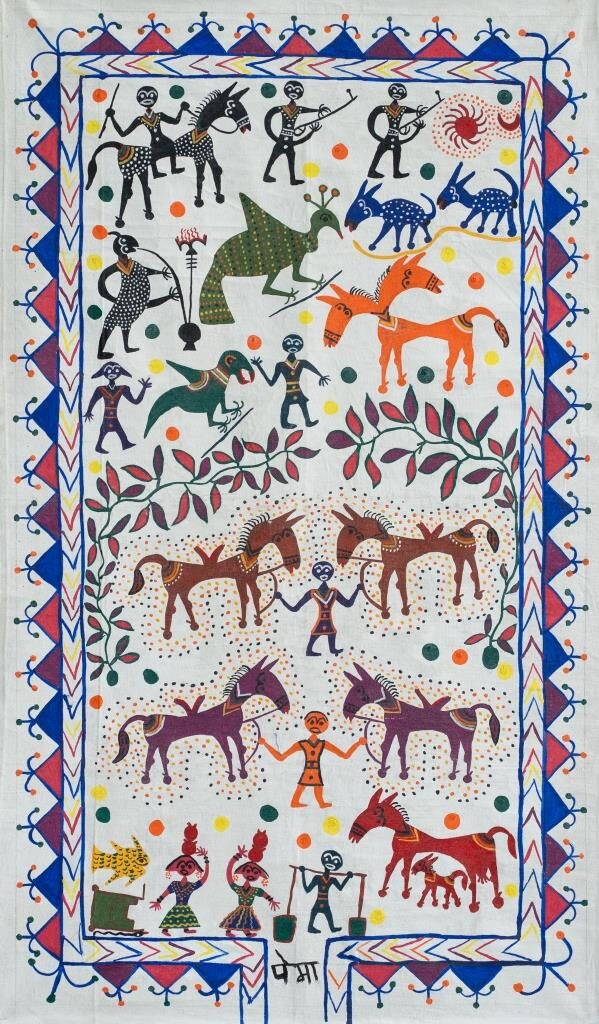
Pema Fatya (1951–2020; Jhabua, Madhya Pradesh) was an artist and lekhindra (hereditary painter) known for his contribution to the Pithora painting tradition. Born into a family of painters, with both his father and grandfather practising the art, he grew up learning a form of painting closely connected to ceremonial life. His early work involved painting on the walls and floors of homes during rituals, often under the guidance of a priest. This early training shaped his understanding of Pithora painting as both an artistic practice and an integral part of community life.
Fatya came to wider recognition in the 1980s when artist Jagdish Swaminathan, then director of Bharat Bhavan, recognised his work and invited him to create paintings for the Roopankar Gallery. Alongside Jangarh Singh Shyam, he was among the early artists to bring Pithora painting into museum and gallery spaces through the medium of canvas. This transition introduced new possibilities for the presentation of the tradition, while allowing Fatya to retain the imagery and compositional structures associated with its ritual origins.
His paintings are distinguished by precise linework, vivid colours and carefully arranged imagery. Horses, deities, ancestral figures and mythological episodes recur throughout his compositions, alongside scenes drawn from ceremonial and everyday life. His treatment of these subjects reflects an intimate knowledge of Pithora iconography and its visual conventions. Despite gaining recognition beyond Jhabua, Fatya continued to undertake ritual commissions, maintaining his involvement in the ceremonial practice of painting. Even after the onset of paralysis, he continued to work.
His works are held in collections including the Museum of Art and Photography, Bengaluru, the Indira Gandhi National Centre for the Arts, New Delhi, Bharat Bhavan, Bhopal, the Madhya Pradesh Tribal Museum and the Madhya Pradesh Tribal Folk Academy. He received the Shikhar Samman in 1986 and the Tulsi Samman in 2017 in recognition of his contribution to art and culture.
Pema Fatya passed away in 2020 in Jhabua. His work occupies an important place in the history of Pithora painting, particularly in its movement from ceremonial settings into contemporary art institutions. His contribution lies not only in sustaining a hereditary practice but also in establishing its place within a wider history of Indian painting.