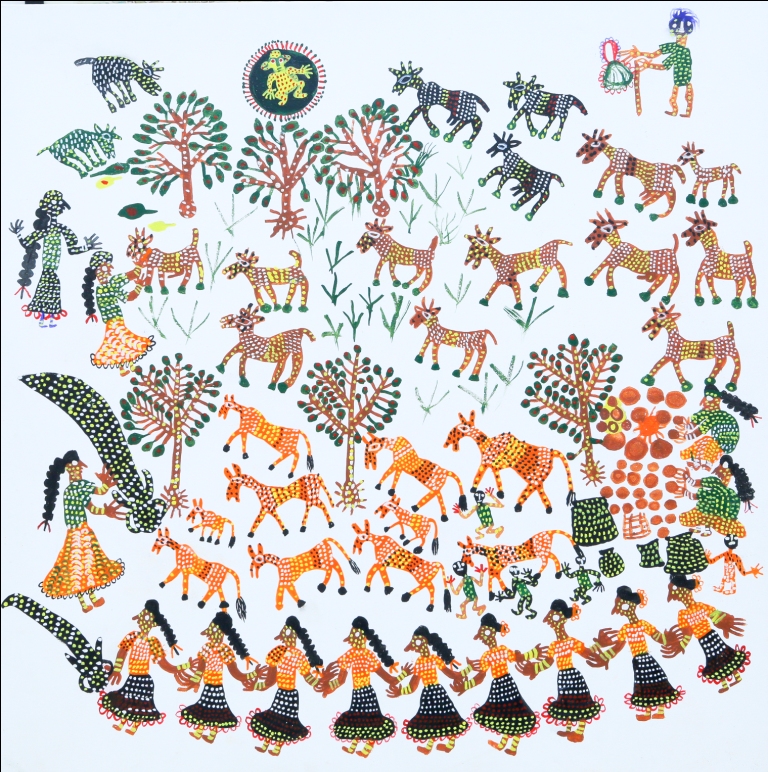
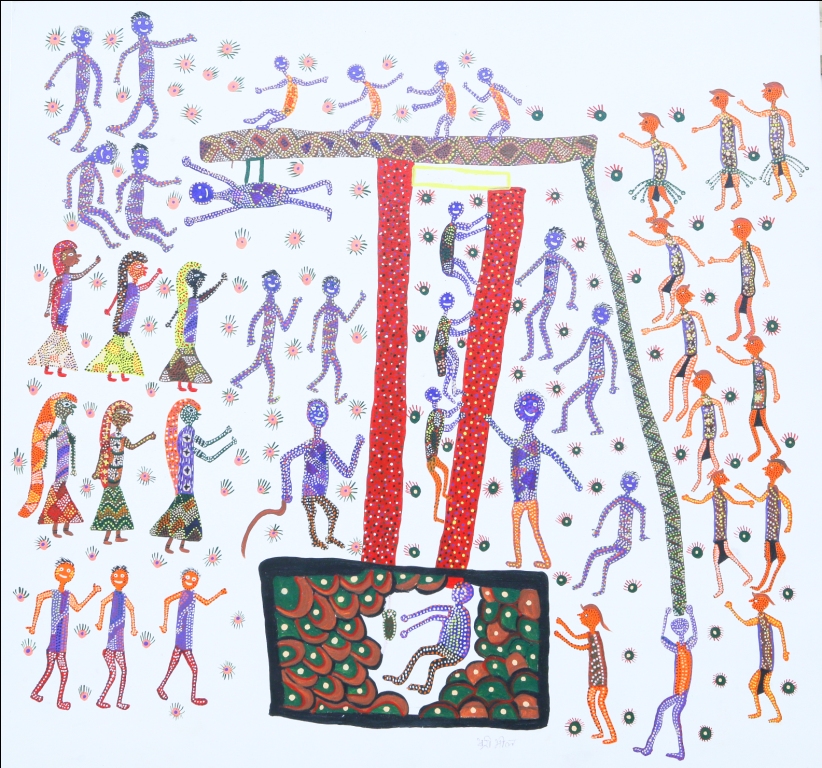
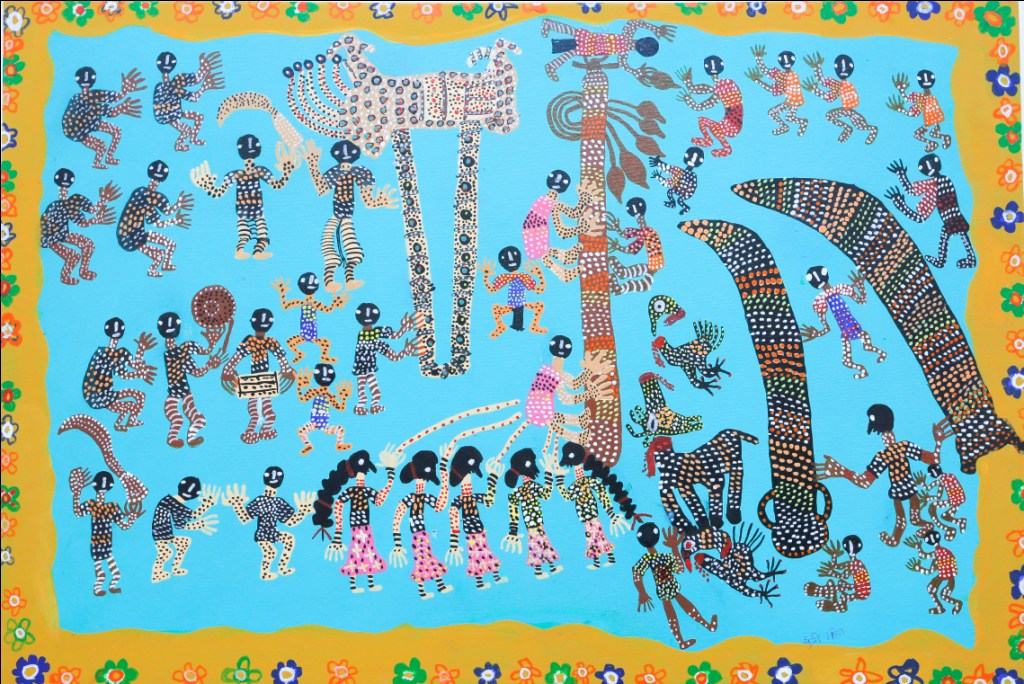
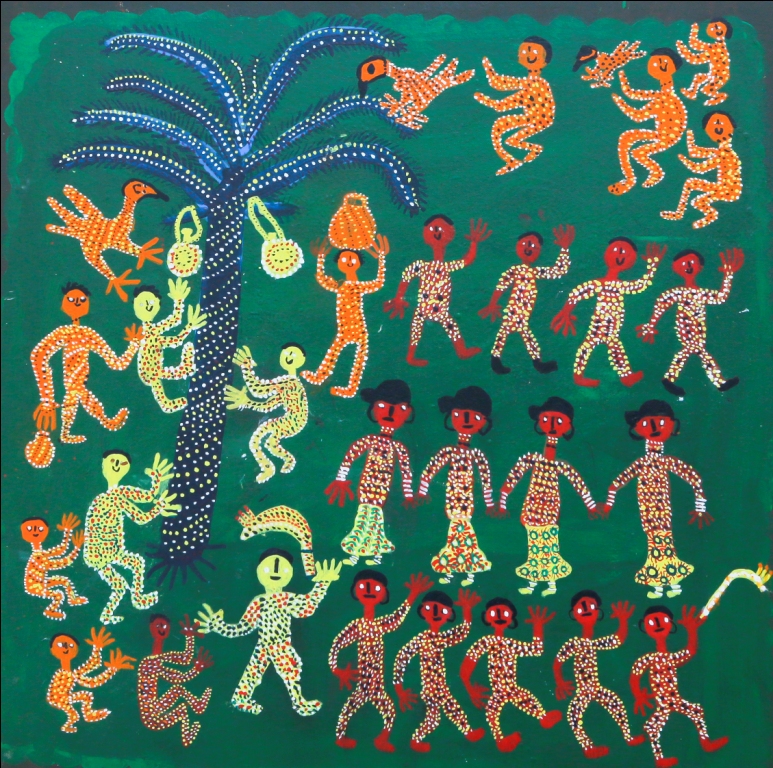
Bhuri Bai (b. 1968; Pitol, Jhabua, Madhya Pradesh) is a pioneering figure in the development of contemporary Bhil painting. Born in the Jhabua region of Madhya Pradesh, she transformed inherited visual traditions into a distinctive artistic language, among the earliest Bhil artists to extensively work on paper and canvas. Her practice emerged through her association with Bharat Bhavan, Bhopal, where she was encouraged by artist J Swaminathan to adapt traditional Bhil imagery into new mediums.
Working with vibrant colours, intricate patterns and densely layered compositions, Bhuri Bai’s paintings draw from Bhil cosmology, village life, memory and relationships between humans, animals and the natural world. Her works retain the narrative richness of community traditions while expanding the possibilities of Bhil painting within contemporary art contexts.
Her work has been presented in exhibitions including Now That the Trees Have Spoken (Pundole Art Gallery, Mumbai, 2009), Other Masters of India (Musée du Quai Branly, Paris, 2010) and Vernacular, in the Contemporary (Devi Art Foundation, 2010). She also participated in Satrangi 2017: An Exhibition of Bheel Art at Ojas Art, which brought together significant contemporary practitioners of Bhil painting.
Her works are held in institutional collections including the Indira Gandhi Rashtriya Manav Sangrahalaya, Bhopal, and the Madhya Pradesh Tribal Museum. Her practice has been documented in publications including Between Memory and Museum (Tara Books, Chennai) and other writings on Bhil art and contemporary Indian visual traditions.
In recognition of her contribution to Indian art and culture, Bhuri Bai was awarded the Padma Shri by the Government of India in 2021. Through her paintings and murals, she has played a defining role in bringing Bhil visual traditions into contemporary artistic discourse while preserving the narrative and ecological knowledge embedded within the form.